
In the contemporary jewelry market, jade bracelets have become a vital vessel of Eastern aesthetics, cherished for their warm texture and profound cultural significance. From imperial exclusivity in Ming and Qing dynasty palaces to modern urban fashion accessories, from religious ritual objects to tokens of affection, the evolution of jade bracelets mirrors the flowing history of Chinese civilization. Below, I will unveil the mystery of this “jewel in the palm” through four dimensions: historical context, symbolic system, contextual applications, and emotional value.
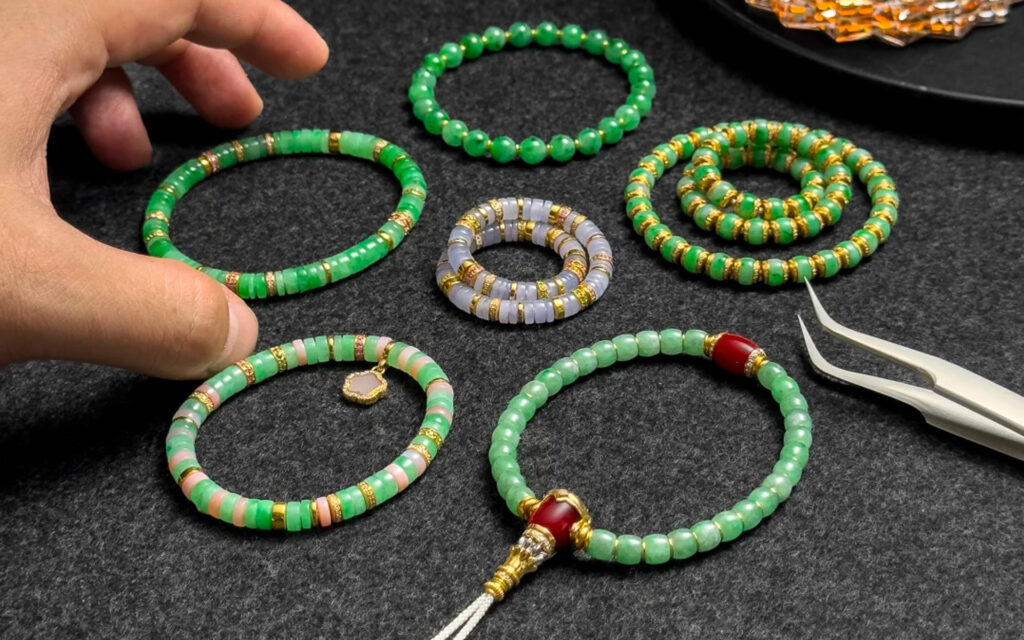
I. Historical Context: A Millennium of Transition from Imperial Treasures to Popular Fashion
(1) Buddhist Origins: The Secular Transformation of Prayer Beads
The prototype of jadeite bracelets traces back to the “prayer beads” of ancient Indian Buddhism. According to the Sutra on the Wooden Beads, Buddhist beads were originally strung from 108 soapberries (Sapindus mukorossi) for counting recitations during sutra chanting. As Buddhism spread eastward, Chinese artisans gradually replaced wooden beads with jade, establishing the unique tradition of “jade bead meditation” by the Tang Dynasty. The Song Dynasty text “Dreams of the Eastern Capital” records the emergence of “Seven Treasures Rosary Shops” in Bianjing’s markets, selling prayer beads inlaid with pearls and agate—signaling the transition from religious tools to decorative accessories.
(2) Ming-Qing Golden Age: Craft Revolution Led by Imperial Aesthetics
During the Yongle reign of the Ming Dynasty, Burmese jadeite rough stones brought back by Zheng He’s maritime expeditions infused new vitality into imperial jade craftsmanship. Qing palace archives reveal Emperor Qianlong commissioned artisans to carve jadeite “eighteen-bead” bracelets, each bead featuring relief carvings of the Eighteen Arhats, paired with tourmaline Buddha heads and ruby clouds. These became coveted fashion accessories among imperial consorts. Empress Dowager Cixi’s obsession with jadeite reached extremes—she commissioned jadeite armor covers, jade hairpins, but also combined jade bracelets with court beads to pioneer the unique “double-strand layered” style. Her treasured “Eighteen Arhats Jade Bracelet,” now housed in the Palace Museum, features beads measuring 1.8 cm in diameter. Crafted from ice-like jade with green hues throughout, it stands as the pinnacle of Qing Dynasty jade carving.
(3) Republican Transformation: From Aristocratic Exclusivity to Mass Collecting
By the early 20th century, with the collapse of the feudal dynasty, jadeite bracelets began circulating among the populace. Shanghai socialite Tang Ying famously wore a “Fortune, Luck, Longevity” tri-color jadeite bracelet to a ball, where its gradient hues of red, green, and violet sparked a wave of imitations. Concurrently, jade merchants in Beijing’s Liulichang district introduced “student-style” bracelets—strung with 6mm beads that preserved the traditional 18-bead format while lowering price barriers, making jade bracelets accessible to ordinary households.
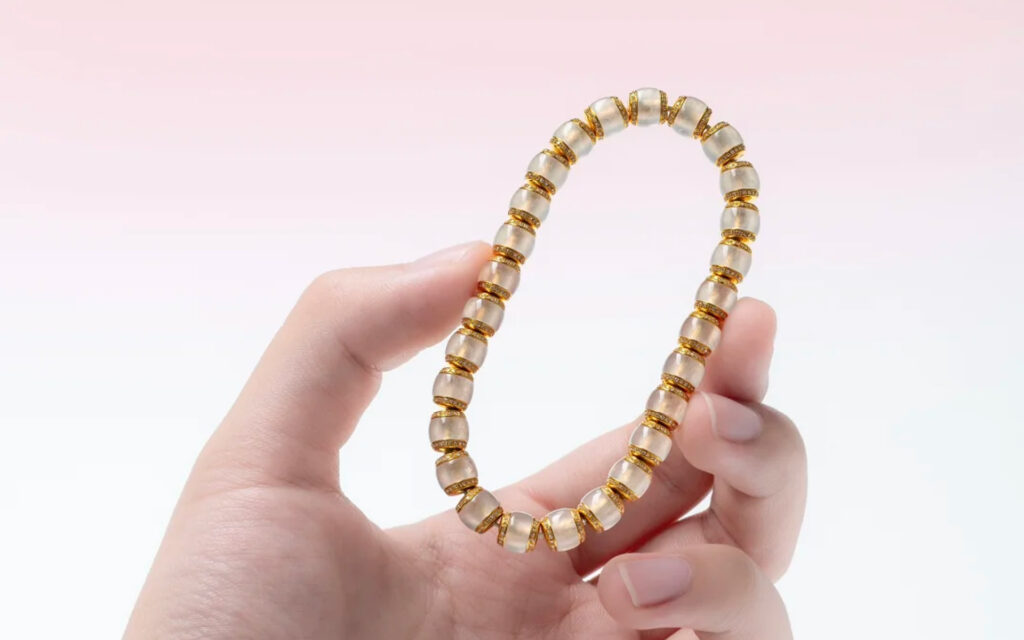
II. Symbolic System: The Profound Codes of Color, Numbers, and Form
(1) Color Philosophy: Eastern Wisdom of Five Elements and Five Colors
Within jadeite’s seven-color spectrum, each hue carries unique symbolism:
Green Spectrum: Symbolizes vitality and hope. The Qing dynasty text Jade Chronicles records, “Green is jadeite, the pinnacle of preciousness.” Imperial green jadeite bracelets, rare in production, were regarded as “spirit-communicating treasures.” Modern psychological research confirms that green reduces cortisol levels and alleviates anxiety.
Purple Spectrum: Originating from the Taoist allusion “Purple Qi Rises in the East,” it symbolizes nobility and mystery. Violet jadeite bracelets are often gifted to newlyweds, signifying “a heavenly union sealed in purple.”
Red hues: Embracing the meaning of “good fortune beckons,” red jadeite bracelets see surging sales during the Spring Festival. Merchants often pair them with golden thread nanmu wood spacers to amplify auspicious vibes.
Combination hues: When two or more colors coexist in a single bracelet, classic combinations emerge—such as “Fortune, Prosperity, Longevity” (green, purple, red) and “Spring in Full Bloom” (purple, green). At Sotheby’s Hong Kong Spring Sale 2023, a “Five-Color Auspicious Clouds” jadeite bracelet sold for HK$8.6 million. Its beads display a gradient of white, green, yellow, purple, and red hues, earning it the collector’s acclaim as “nature’s palette.”
(2) Numerical Symbolism: From Religious Rituals to Secular Blessings
The selection of bead counts in jadeite bracelets carries profound cultural logic:
18 beads: Derived from Buddhism’s “Eighteen Realms” theory (six roots, six dusts, six consciousnesses), folk tradition evolved the belief of “protection by the Eighteen Arhats.” Modern professionals favor this number, believing it can “resolve 18 workplace challenges.”
108 beads: Corresponding to Buddhism’s concept of “108 afflictions,” commonly seen in long bracelets. Actress Liu Xiaoqing once wore a 108-bead ice-type jadeite bracelet to a film festival. Each bead measured just 4mm in diameter, requiring artisans three months of hand-polishing.
Special numbers:
8 beads symbolize “wealth from all directions,” ideal for business gifts;
13 beads signify “perfect merit,” often given as birthday presents;
27 beads represent the “Three Vehicles of Sages,” typically worn by spiritual practitioners.
(3) Design Language: An Aesthetic Evolution from Conventional to Innovative
Traditional jadeite bracelets primarily feature round beads, while modern designers break free from these form constraints:
Carved Themes: Incorporating elements like Buddhist statues, zodiac animals, and pi xiu into bead surfaces—such as the “Twelve Zodiac Guardian Spirits” series bracelets, where each bead corresponds to a zodiac sign, making them ideal for family wear.
Non-Circular Beads: Barrel beads, antique-style beads, abacus beads, and other non-spherical forms challenge traditional aesthetics. At the 2024 Beijing Poly Auction, a bracelet composed of 18 antique-mined glass-like barrel beads sold for 12 million yuan, setting a record for such pieces.
Mixed-Style Designs: Combining jadeite with materials like South Sea coral, amber, and turquoise creates “multi-gem bracelets.” Shanghai jade carving master Wang Jinzhong’s “Four Seasons Multi-Gem” bracelet, featuring jadeite as the main element paired with seasonal-themed gemstones, has become a new favorite among collectors.
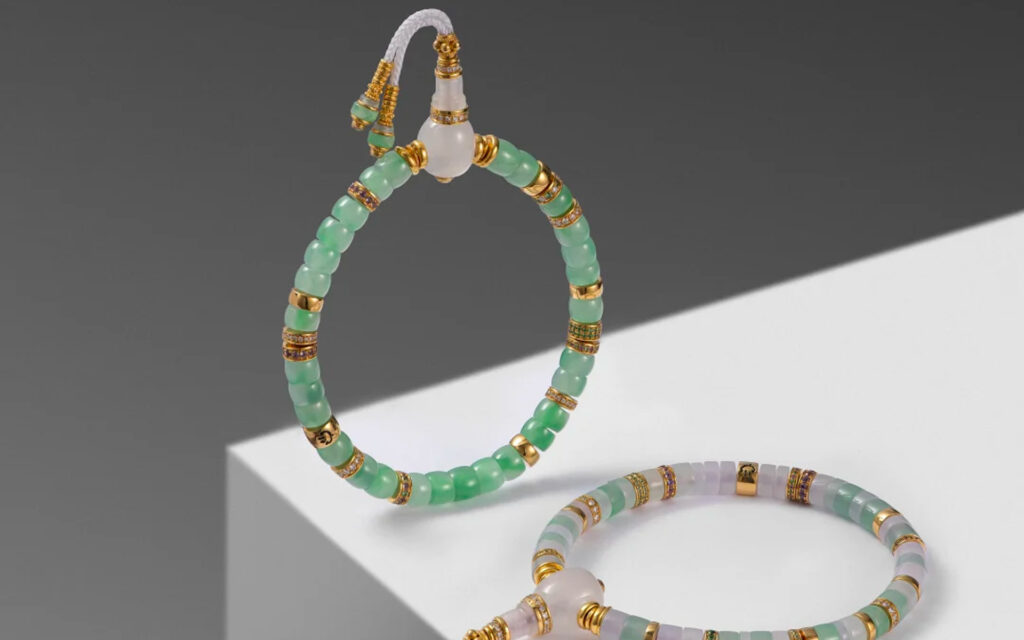
III. Scenario Applications: Diverse Expressions from Daily Wear to Cultural Heritage
(1) Business Settings: The Invisible Calling Card of Identity
At high-end business banquets, a premium jadeite bracelet often carries more persuasive weight than a luxury watch. A multinational corporation’s China president once shared: “When shaking hands with clients, their gaze always lingers briefly on the jade bracelet on my wrist—this understated Eastern aesthetic builds trust more effectively than overt brand logos.” Data indicates that by 2025, the median budget for jade bracelet purchases among corporate executives will reach 80,000 yuan, with 60% allocated for significant business occasions.
(2) Everyday Style: Modern Interpretations of Eastern Aesthetics
Young consumers are redefining jade bracelet styling with innovative approaches:
Layering Trend: Combining jade bracelets with metal chains or smartwatches creates a “traditional meets modern” clash. Post by Gen Z influencer “Jade Deer” on Xiaohongshu demonstrating “jade + titanium steel” layering garnered over 100,000 likes.
Seasonal Coordination: Selecting bracelets by color for different seasons and occasions—spring pairs with green jadeite, summer with violet, autumn with yellow, and winter with red. A fast-fashion brand even launched a “Four Seasons Jadeite Bracelet Gift Set” containing four interchangeable strands to meet year-round styling needs.
(3) Family Heirlooms: Emotional Containers Transcending Time
Within family legacies, jade bracelets play a unique role:
Material Legacy: Old-mine glass-like jade bracelets, due to their scarcity, see annual appreciation rates of 15%-20%. An auction house expert notes: “The collectible value of Qing Dynasty jade bracelets lies not only in their material but also in the historical information they carry—details like wear marks on the beads and stringing methods are crucial evidence for determining their age.”
Spiritual Legacy: The Zhang family of Shanghai uses a passed-down jadeite bracelet as a “carrier of family precepts”—each bead symbolizing a core value like “integrity,” “resilience,” or “innovation.” Family members receive the bracelet at their coming-of-age ceremony and add new beads at significant life milestones, marking their journey of growth.
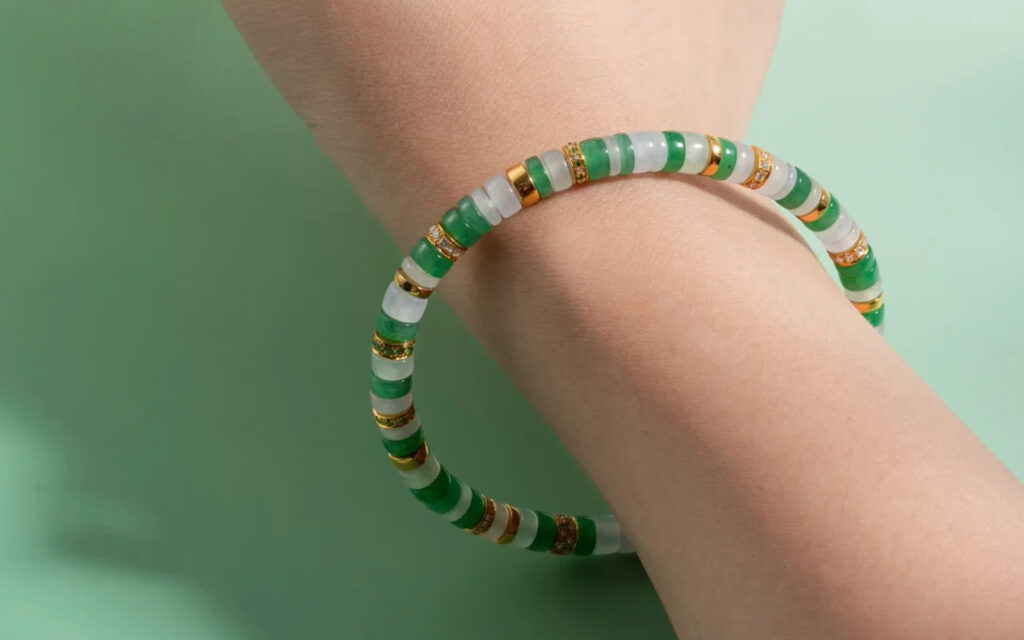
IV. Emotional Resonance: From Physical Adornment to Spiritual Protection
(1) The Talisman Effect: A Psychological Anchor Beyond Scientific Explanation
Psychological experiments reveal that individuals wearing jade bracelets exhibit a 12% higher heart rate variability (HRV) during stress tests compared to control groups, indicating its emotional regulation properties. A cancer survivor shared: “Throughout chemotherapy, I clutched the jade bracelet my mother gave me. Its warm, smooth touch brought me comfort—perhaps an ‘energy field’ science can’t explain, but it truly gave me the strength to overcome my illness.”
(2) Emotional Bonds: A Transgenerational Aesthetic Dialogue
When Gen Z transforms their grandmother’s jade brooch into layered bracelets, and Millennials use 3D printing to recreate Qing Dynasty “eighteen-bead” designs, jade bracelets become conduits for intergenerational connection. A jewelry brand’s “Grandparent-Grandchild Customization Service” allows young people to reimagine family heirlooms by combining vintage pieces with new jadeite purchases, preserving memories while embracing contemporary aesthetics. Within three months of launch, the service received over 2,000 orders.
(3) Cultural Identity: Global Expression of Eastern Aesthetics
In overseas Chinese communities, jadeite bracelets serve as cultural identity markers. New York jade collector Ms. Lin remarked, “At every chamber of commerce event, seeing jade bracelets on everyone’s wrists feels like glimpsing the moon back home—though living abroad, that sense of cultural belonging never fades.” Data indicates China’s jade bracelet exports will reach $4.5 billion by 2025, with Southeast Asia and North America accounting for over 60% of the market, cementing jade as a vital conduit for Chinese cultural export.